
On this page
You got a raise this year. Your gross salary is now €80,000, comfortably above the €77,400 limit for private health insurance in 2026. A colleague tells you to switch before New Year. For many employees in this situation, that advice is wrong – and the reason has nothing to do with the new 2027 figure alone.
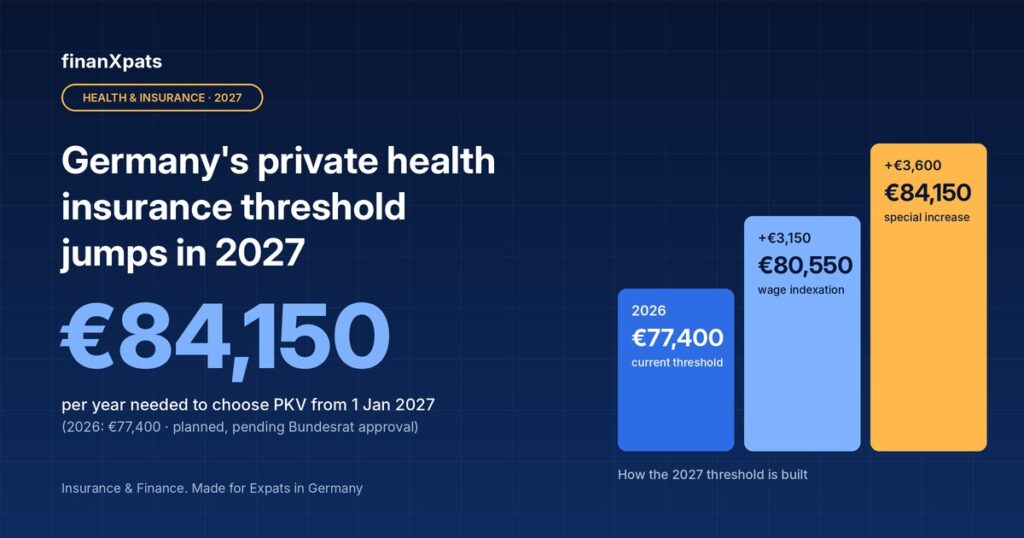
Germany plans to raise the income threshold for private health insurance (PKV) to €84,150 a year (€7,012.50 a month) from 1 January 2027, up from €77,400.
If you are a compulsory member of public health insurance (GKV) today, a 2026 salary above €77,400 is usually not enough to leave: your salary must also exceed the threshold that applies in 2027. If you are already a voluntary member, you can still switch – but your private policy must be in force by 31 December 2026. The Bundesrat is expected to approve the new values on 20 November 2026.
The rule most people miss: crossing the threshold is not enough
Compulsory insurance (Versicherungspflicht) does not end the moment your salary passes the threshold. It ends at the end of the calendar year – and only if your salary will also be above the threshold that applies in the following year.
In a normal year, this second condition rarely matters. In 2027, the threshold rises by €6,750 at once. That turns a technical detail into a decision point for many employees earning between €77,400 and €84,150.
You are an engineer and a compulsory member of public insurance. Your regular salary rises to €80,000 in 2026. That is above the 2026 threshold, but below the planned 2027 threshold of €84,150. Your compulsory insurance therefore continues on 1 January 2027, and switching to private insurance at the turn of the year is not possible.
2026 vs 2027: the planned values
| Threshold | 2026 | 2027 (planned) |
|---|---|---|
| Compulsory insurance threshold (choice of PKV) | €77,400 | €84,150 · €7,012.50 / month |
| Employees privately insured on 31 Dec 2026 | – | €80,550 · €6,712.50 / month |
| Employees privately insured since 31 Dec 2002 | €69,750 | €72,900 · €6,075 / month |
| Contribution ceiling, health and long-term care | €69,750 | €76,500 · €6,375 / month |
| Contribution ceiling, pension and unemployment | €101,400 | €106,200 · €8,850 / month |
Annual gross values. Approved by the Federal Cabinet on 7 October 2026; binding only after Bundesrat approval and publication in the Federal Law Gazette.
Why the big jump? On top of the usual wage indexation (4.38 percent), the GKV Contribution Rate Stabilisation Act adds a one-off increase of €300 a month to both health insurance thresholds.
Who can still switch – and who can’t
| Your situation today | Switch to PKV? | What to do |
|---|---|---|
| Voluntary member of GKV, salary above €77,400 in 2026 | Yes, in 2026 | If PKV is right for you, get your policy in force by 31 December 2026. From 2027 you would need more than €84,150. |
| Compulsory member, salary crossed €77,400 only in 2026 and stays below €84,150 in 2027 | Generally no | Your status continues in 2027. Re-check when your salary passes €84,150. |
| Compulsory member, salary above €84,150 in 2026 and 2027 | Yes, from 1 Jan | Prepare the switch now so cover starts on 1 January 2027. |
| Privately insured on 31 Dec 2026, salary at least €80,550 in 2027 | You stay private | Nothing to do. |
| Privately insured on 31 Dec 2026, salary below €80,550 in 2027 | Exemption possible | You become compulsorily insured but can usually apply for an exemption by 31 March 2027. |
| Self-employed, civil servant (Beamter) or student | Different rules | The employee salary threshold does not apply to you. |
Compulsory or voluntary? Ask your HR or payroll team, or check the membership letter from your health insurance fund. “Freiwillig versichert” means voluntary; “pflichtversichert” means compulsory.
GKV or PKV – what would you pay?Compare public and private health insurance with your salary and year of birth.
Open the GKV vs. PKV calculatorWhat counts as your salary
The test uses your regular annual gross pay: your monthly salary times twelve plus guaranteed extras, such as a contractual 13th month salary. Bonuses that are not guaranteed are generally left out. Your employer makes the assessment.
Already private? The new grandfathering rule
Employees who are exempt from compulsory insurance and privately insured on 31 December 2026 keep a lower threshold. For them, the planned 2027 threshold is €80,550 – the regular wage indexation without the extra €3,600.
If your 2027 salary falls below €80,550, you become compulsorily insured. In that case you can generally apply for an exemption (Befreiung von der Versicherungspflicht) within three months, so by 31 March 2027. Think carefully before you apply: an exemption is generally binding for as long as the employment lasts.
Starting a new job around the turn of the year
If your job in Germany starts in 2026 and your expected regular salary is above €77,400, you are exempt from the start and free to choose private insurance. If you are privately insured on 31 December 2026, the €80,550 threshold applies to you from 2027. A job that starts on or after 1 January 2027 is measured against €84,150.
Because start dates and contract details matter here, confirm your status with your employer before you sign a private policy. Arriving from abroad? Our guide to health insurance for your German visa explains how to stay covered until your job begins.
What to do in November and December
- Check your statusFind out whether you are a compulsory or a voluntary member today.
- Check your 2027 salaryCompare your regular gross salary with €84,150, or with €80,550 if you are already privately insured. Then check what each system would cost you with our GKV vs. PKV calculator.
- Start earlyPrivate insurers assess your health before they accept you. Questionnaires, medical records and underwriting can take several weeks.
- Mind the notice periodLeaving public insurance requires notice to your fund. Ask your fund for the exact date, and make sure your private policy is in force by 31 December 2026.
- Tell your employerPayroll needs to set up the employer subsidy for private insurance.
- Watch 20 NovemberThe Bundesrat is expected to decide on the new values that day.
If you stay public: what changes for you
The official average additional contribution (Zusatzbeitrag) for 2027 is fixed at 2.9 percent, unchanged from 2026. Together with the higher contribution ceiling, the maximum employee share for health insurance rises:
| Maximum employee share, health insurance | 2026 | 2027 |
|---|---|---|
| Per month | €508.59 | €557.81 |
| Difference | – | + about €49 / month · €591 / year |
For salaries at or above the contribution ceiling, based on 14.6% plus the average additional contribution of 2.9%, employee half. Long-term care insurance comes on top; your own fund may charge more or less than the average.
Want to compare both systems with your own numbers? Try our GKV vs. PKV calculator (public vs. private health insurance).
Before you decide: a choice for decades
A deadline is a poor reason to change systems. Private insurance can be a very good fit, but the decision should rest on your life, not on the calendar:
- Family: Public insurance can cover a non-working partner and children free of charge. In private insurance, everyone pays their own premium.
- Health: Pre-existing conditions can lead to surcharges or exclusions.
- Coming back: Returning to public insurance later is restricted, and from age 55 it is generally no longer possible.
- Plans: Part-time work, parental leave or leaving Germany affect both systems differently.
Our Health Insurance Guide 2027 compares both systems in detail, and the GKV vs. PKV calculator shows the numbers for your situation.
For HR and global mobility teams
Many offers for engineers, developers and specialists land between €77,000 and €85,000. From 2027, “you can choose private health insurance” is only true above €84,150. Expect questions from employees who received a raise in 2026 and assume they can switch at New Year: as compulsory members, most of them cannot. Update offer templates and relocation information now. More for employers: finanXpats for employers & relocation agencies.
Frequently asked questions
What is the income limit for private health insurance in Germany in 2027?
Under the regulation approved by the Federal Cabinet, employees can choose private health insurance in 2027 if their regular gross salary exceeds €84,150 a year (€7,012.50 a month). The value becomes final after Bundesrat approval.
I earn €80,000 and I am publicly insured. Can I still switch?
It depends on your status. As a voluntary member, yes: your private policy must be in force by 31 December 2026. As a compulsory member whose salary passed €77,400 only in 2026, generally no – your salary would also have to exceed €84,150 in 2027.
I am already privately insured. Will I be forced back into public insurance?
Not if you were exempt and privately insured on 31 December 2026 and your 2027 salary is at least €80,550. If it is lower, you can generally apply for an exemption within three months.
Does the change affect freelancers or civil servants?
No. Their access to private health insurance does not depend on the employee salary threshold.
When do the new values take effect?
They are planned to apply from 1 January 2027, after approval by the Bundesrat and publication in the Federal Law Gazette.
Questions about your case?
If your salary is close to the new threshold, a short conversation before December can spare you a decision made under time pressure. finanXpats helps international professionals compare public and private health insurance – free first call in English, German or Turkish. As an Allianz General Agency, we are transparent about the options we offer, including when staying public is the better choice.
Sources
- German Federal Government: Beitragsbemessungsgrenzen sollen ab 2027 steigen, 12 October 2026
- Federal Ministry of Health: Wechsel zwischen GKV und PKV
- Federal Ministry of Health: Durchschnittlicher Zusatzbeitragssatz 2027 festgelegt, 30 October 2026
- Techniker Krankenkasse: SV-Update FAQ for employers, 20 August 2026
- Association of Private Health Insurers: Neue Versicherungspflichtgrenze – was sich für Sie ändert
Sources checked 4 November 2026. The 2027 values are planned until Bundesrat approval. This article provides general information and is not personal advice.

This page gives general information and does not replace personal advice. Tax aspects are not considered; finanXpats does not provide tax advice.